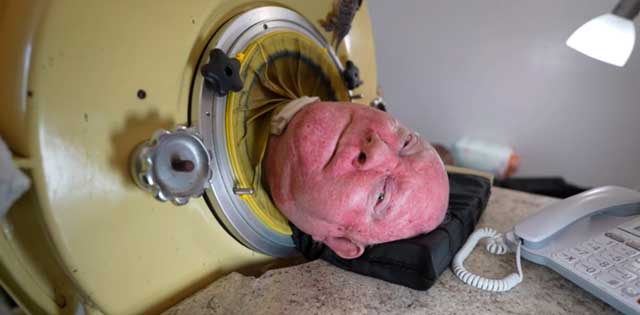
Paul Alexander, who is 76 years old, has lived an extraordinary life. He has been using an iron lung for the majority of his life and is one of the last people in the world to utilize the 1928-era respirator.
Despite his unusual circumstances, he has led a very fulfilling life and has never settled for anything less.
“I will not allow anyone to impose limitations on my life.” That is not something I will do. My life is great.

When Paul was six years old, he raced inside his family’s home in a Dallas suburb and told his mother he wasn’t feeling well. Paul had always been a healthy, cheerful, and active child since his birth in 1946, but something was wrong today.
Paul remembers his mother saying to him, “Oh my God, not my son.”
He spent the next three days recovering in bed, as prescribed by the doctor, but the child clearly had polio and was not improving. He lost his ability to swallow, breathe, or hold anything in his hands less than a week after initially feeling ill.
When his parents arrived at the hospital, he joined a slew of other children with similar symptoms.
Before polio vaccines were available, the infection killed over 15,000 people. Polio, a potentially hazardous infection, can spread even when an infected person exhibits no symptoms.
Polio signs and symptoms include fatigue, fever, stiffness, muscle soreness, and vomiting. Polio can potentially cause paralysis and death in rare cases.

Home » Faith in humanity
Do you remember the man in the iron lung? Look at him today…
Faith in humanity
Author
Lilit
Reading
7 min
Views
106
Published by
25.08.2022
Paul Alexander, who is 76 years old, has led a life that is unique. He has used an iron lung for the most of his life and is one of the last persons in the world to still be utilizing the 1928-era respirator.
He has led a life that is very fulfilling despite his odd circumstances, and he has never settled for anything less.
“I won’t consent to anyone placing restrictions on my life. I won’t do that. My life is amazing.
Paul ran inside his family’s home in a Dallas, Texas, suburb when he was just six years old and informed his mother that he wasn’t feeling well. Paul had always been a healthy, happy, and active youngster since his birth in 1946, but now it was obvious that something was amiss.
Paul recalls his mother saying, “Oh my God, not my son.”
In accordance with the doctor’s recommendations, he spent the following few days recuperating in bed, but the youngster plainly had polio and was not improving. Less than a week after he first felt sick, he lost his ability to swallow, breathe, or grasp anything in his hands.
When his parents finally arrived at the hospital, he joined countless other kids who were suffering from comparable symptoms.
Before polio immunizations were available, the virus incapacitated more than 15,000 people. Even when an infected individual shows no symptoms, polio, an extremely dangerous infection, can spread.
Fatigue, a fever, stiffness, muscle discomfort, and vomiting are some of the signs and symptoms of polio. Polio can, in rarer instances, also result in paralysis and death.
After being evaluated by a doctor who declared him dead, Paul was given a second chance at life by a different doctor.
After the emergency tracheotomy was completed by the second doctor, Paul was then put inside an iron lung.
Three days later, when he finally came to, he found himself among numerous rows of kids who had also been fitted with iron lungs.
”I didn’t know what had happened. I imagined all kinds of things like I had passed away. I kept thinking, “Is this what death is like?” Is that a casket? The Texan asked As It Happens anchor Carol Off, “Or have I gone to some bad place?” in 2017.

The fact that Paul couldn’t communicate because of his tracheotomy added to the dread of the scenario.
I attempted to move but was unable to do so. Not even one finger. I tried to touch objects to figure it out, but I was never successful. As a result, it was strange.
The apparatus, which was designed in the late 1920s, was the first to ventilate a human. The apparatus is hermetically sealed from the neck down and creates a negative pressure in the chamber, sucking air into the patient’s lungs. In the beginning, it was referred to as the “Drinker respirator.” If it causes overpressure, the patient exhales as the air is forced out of the lungs once more.

For 18 months, Paul healed from the original infection contained within the metal canister. He wasn’t the only one. According to the data, Paul developed the sickness in 1952, which was a rather bleak year.
Over 58,000 people, largely children, were infected with the virus in the United States in 1952. Sadly, 3,145 of them died.
As far as the eye can see, there are rows and rows of iron lungs. “Full of kids,” he said.
Some people may have lost interest in life, but Paul was invigorated by it.
Every time a doctor passed by, he heard them say things like, “He’s going to die today” or “He shouldn’t be alive,” and he wanted to prove them wrong.

When he was released from the hospital in 1954, he recognized that his life had drastically changed.
He stated in a video interview in 2021, “People didn’t like me very much back then.” “I got the impression that they were uneasy with me.”
But, with the help of Mrs. Sullivan, a therapist who came to see him twice a week, his life began to improve gradually. His therapist offered to purchase him a puppy if he could “frog-breathe” for three minutes without the iron lung, a way of trapping air in your mouth that involves flattening your tongue and widening your throat.

Paul was able to spend more and more time outside the iron lung after a year of laborious effort.
At age 21, he became the first individual to earn an honors diploma from a Dallas high school without ever showing up in person. After receiving multiple rejections, he finally set his sights on attending college and was admitted by Southern Methodist University.
He recalled, “They stated I was too disabled and did not receive the immunization.” After two years of my harassing them, they agreed to two things. Two things: first, that a fraternity would be in charge of me; and second, that I receive the polio vaccine.
After graduating from Southern Methodist University, he went on to the University of Texas at Austin to pursue a legal education. He passed the bar exam and started practicing law in the Dallas–Fort Worth region.
I was also pretty damn good at it.

Even after a 30-year career in the courtroom, he kept himself busy by writing a book, which he typed entirely by hand using a pen attached to a stick.
Paul is said to be one of the last people to live within the practically extinct machine. The 76-year-old has spent the majority of his life in a can, confined to his antique iron lung.
I’ve taken it on trips with me and loaded it into a vehicle. It went with me to college, where I lived in a dorm. That terrified everyone, he stated.
Because modern ventilators are so complex and high-tech, Paul’s specific type of iron lung hasn’t been manufactured in fifty years.
Despite the availability of new technology, the polio survivor prefers his metal chamber. When the metal lung was on the verge of failing seven years ago, the Dallas attorney was obliged to post a frantic YouTube message. Fortunately, there are still abandoned computers all across the country, which means that replacement parts are plentiful. Paul has also received help from avid users of obsolete technologies.

“Many people who had polio are no longer alive.” What happened with the iron lung? They were discovered in barns. They were kept in garages. They were found in salvage yards. He maintains there isn’t much, but there is plenty to scavenge for parts.
Paul, who has outlived his parents and older brother, is currently working on his second book.
Paul remarked that since he “never gave up,” he was able to live such a meaningful life.

He remarked, “I wanted to achieve the things I was told I couldn’t achieve and to dream the dreams I dreamed.”
Since 1979, polio has been virtually eradicated in the US. However, sporadic cases of polio caused by vaccination continue to be a source of worry.
Watch the video below: