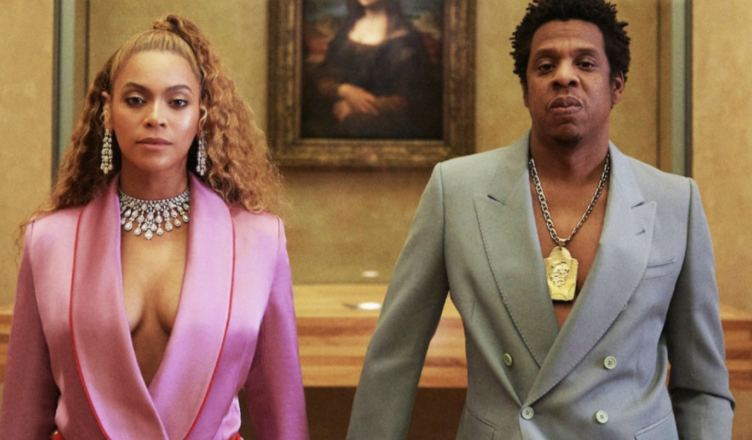
Everything Jay-Z says makes headlines, but this time he really outdid himself. During Alicia Keys’ Twitter Spaces chat with Genius’ Rob Markman in celebration of her latest album KEYS, Jay-Z took it upon himself to explain why his wife Beyonce is an evolved version of Michael Jackson in a way that should come as no surprise to anyone who has been paying attention to how Jay moves through culture.
At one point during the nearly two-hour conversation, Markman asks Keys and Jay to elaborate on their experiences making music with their respective children. Each of them expressed parental delight in witnessing their children begin their musical careers at an earlier age than either of them. Jay cited their children’s early musical exposure as evidence of how generations are supposed to evolve from prior generations. Jay then made a logical leap that involved a legend from the past being overshadowed by an icon from the present.
“[Beyonce] is going to be upset that I’m saying this, but Michael Jackson never had a Coachella….” “She’s an evolution of him because she saw him when she was (age) nine,” he remarked, referring to his wife’s outstanding HBCU-inspired performance, which was later immortalized in the film and live album Beyonce: Homecoming. “Try to find another concert that is as culturally relevant and exciting as Coachella.” Because she is such a student, Beyoncé is going to be one of the best singers we’ve ever heard.”
Jay-Z on never doing a #VERZUZ battle “There’s not a chance anyone can stand on that stage with me” on @TwitterSpaces w/@aliciakeys @Genius @RobMarkman @Kozza @sc pic.twitter.com/Wh6IEdZfKQ
— ً (@JustJordan_925) December 22, 2021
Following this surprising declaration, Jay appeared to imply that he, too, would be overtaken, declaring at one point that youth will always outdo their predecessors. That doesn’t mean he’ll let recency bias drag his illustrious catalog down from the top slot just yet. Months of online debate about who could compete with Jay in a VERZUZ duel were put to rest when the God MC confidently stated, “No one can stand on that platform with me.” Nobody should be surprised that Jay reveres the past while elevating the present, because that’s how he’s remained culturally relevant all this time.
Jay has fashioned himself as an old soul in chameleon skin, never forgetting his roots while cherishing the future rewards of his labor, since he admittedly quit chasing Billboard chart confirmation and became a champion of tradition disruption. The same man who mocked Twitter by rapping “fuck hashtags and retweets” has probably spent more time on Twitter Spaces this year than you have. He’ll rework Vine’s viral success “Damn Daniel” as a sly homage to the FBI surveillance he endured throughout his years as a drug dealer, something his day-one followers love to hear. Fans are unlikely to buy Jay-Z songs because, as he puts it, “somewhere in America, Miley Cyrus is still twerking,” but he does endear himself to both younger and older generations by backing artists like Griselda who are new voices for the types of stories he’s made famous.
His Beyonce/Michael Jackson views reflect the same evolutionary perspective as his disruptive deconstruction of music industry standards. He has advocated for emerging technologies such as smart contracts, clarifying their potential impact on both past and present artists. Jay cited Jean-Michel Basquiat’s Untitled sale for $110 million without the painter’s family receiving any royalties as proof that smart contracts on the blockchain are the way of the future because of their ability to ensure original creators receive compensation on each sale of the art. In a Twitter Spaces conversation with Alicia Keys, he discussed how the music industry’s fixation on the past has harmed its future.
“I’m sure there’s language in [Alicia Keys’] contract that was in Chuck Berry’s contract,” he remarked, referring to the late 1950s rock and roll pioneer. “We still have antiquated language that has to modernize.”
Because of his understanding of the past and present, he sold Tidal to Jack Dorsey’s firm, formerly known as Square, which resulted in Tidal breaking the conventional arrangement of artist royalties by allowing members to pay artists directly. His delicate blend of nostalgia and recency bias may land him in hot water for elevating anyone over the great Michael Jackson, but it also keeps him relevant in pop culture by bringing the past and the present together.