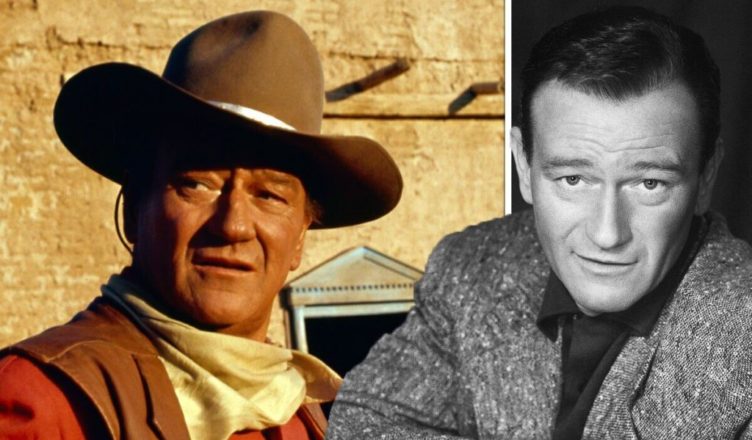
John Wayne’s career established him as one of the most well-known performers of all time. The star of “True Grit” began his career in a very different industry, but he went on to become the most famous movie star of his era.
John Wayne was a well-known family guy who also acted in a number of films. He married three times and had seven children from each of his marriages. And, while some performers’ children recall their parents being absent when they were little, John Wayne was not one of them.
Since his sad death, some of his kids have talked about him in public, letting everyone know the truth. Here’s everything you need to know about John Wayne, including how his life ended in tragedy.

John Wayne was not his given name. Instead, the legendary entertainer was born Marion Morrison on May 26, 1907, in Winterset, Iowa. His first “name change” occurred while he was a child. It was due to the fact that his parents, Clyde and Mary, owned an Airedale dog named Duke.
“There’s a drawing of him in the book,” Marion called him Little Duke since he appeared to weigh around 80 pounds. According to biographer Scott Eyman, “he liked the name, and for the rest of his life, he always insisted that people call him Duke.”
When Wayne was 9 or 10, his family made the decision to move to Glendale, California. His dad started working there as a pharmacist, but the family ran into a lot of problems along the way. Simply put, it turned out that it wasn’t easy to make it in California. In the end, John Wayne got to see a lot of things that helped him become the person he is today.

Because of this, his stay there most likely benefited him greatly in the long term.
“There’s this young boy whose father is ill, and he and his family relocate to the western Mojave Desert to try to farm.” “That’s a hard place to farm, and they fail,” Wayne’s father, Ethan, said of his father’s boyhood. “He has a very tough, demanding mother.”
“It’s difficult for the father, and he’s never happy about it.” They eventually arrive in Glendale, which was a little town in the country at the time. The father was pleasant, but the mother was a bit strict. I believe [John] found solace in school and the individuals he met.”
John attended Glendale High School, where he first became interested in acting. He excelled in his courses and played football, among other things. He was also involved in student theater projects.

He was the school newspaper’s chief editor, the debate team’s captain, and a member of the dance committee and the drama club.
Wayne was also the football team’s captain. He helped lead the team to a championship season and earned a football scholarship at the University of Southern California. He was a terrific student at first, but school was too expensive, so he dropped out and went to work. Obviously, that wasn’t the only reason he dropped out of college.
No, it appeared like young John Wayne would become an NFL player. He was brilliant at what he did and aspired to get better, but he injured himself while bodysurfing in 1926.
So Wayne secured a job at a nearby movie studio, where he worked as a prop man as well as an extra in a few films. There, he encountered some of the most influential figures in the film industry, including John Ford, who taught him a lot.
“I was a carpenter and a juicer.” I helped set up lighting and put together sets. Things have been moved. “I learned the nuts and bolts of making movies,” Wayne claimed, as reported in Scott Eyman’s John Wayne: The Life and Legend.
Wayne first collaborated with Ford on the set of the 1928 film Mother Machree. His job entailed herding geese. Many others recognized him because he had previously worked at the studio. Raoul Walsh, the filmmaker who gave John his first job, was one of these people. John was still known as Marion Morrison at the time.
Soon after, he landed the lead role in the 1930 film The Big Trail, and it was on the set of that film that his name would forever change.

“Winfield Sheehan, who ran Fox Studios, was a big fan of ‘Mad Anthony’ Wayne, a Revolutionary War general. That’s where the name ‘Wayne’ came from. The name ‘John’ came up in conversation because it seemed to fit with ‘Wayne’: ‘John Wayne.’ It was well put together.”
From then on, Marion, whose family called him “Duke,” was known as John Wayne. It was also the start of one of the most famous careers in the history of movies.

Following that, Wayne went on to make a number of excellent films. First, in 1939, he appeared in the classic film Stagecoach. He scored several hits in the 1950s, including The Quiet Man, Rio Bravo, and The Man Who Shot Liberty Valance. In 1969, he appeared in the film True Grit.
Despite his rapid celebrity, John Wayne did not consider himself a major star. Instead, he assumed that “Duke Morrison” and “John Wayne” were two distinct people inhabiting the same body.
Wayne stated in 1957, “The guy you see on the screen isn’t really me.”
“My name is Duke Morrison, and I was never, and never will be, a movie star like John Wayne.” I’m really familiar with him. I’m one of his favorite students. I have to be. He is the source of my income.”
Nowadays, many actors prepare for parts by imagining themselves as the characters they will play. Being genuine to the character is an important component of impersonating someone else, thus a skilled actor will want to know everything about their role.

This was not John Wayne’s only manner of doing things. Eyman stated that he insisted on being addressed by his childhood nickname, Duke.
In his autobiography, Eyman writes, “In Wayne’s own mind, he was Duke Morrison.” “John Wayne was to him what the Tramp was to Charlie Chaplin: a character who overlapped his own personality, but not so much that it took over.”
He stated in 1975, “I’ve always been Duke, Marion, or John Wayne.” “It’s a good combination of names, and it sounds like one word: JohnWayne.”
After his film career took off, John married and had a child. His personal life, on the other hand, was full of surprises.
In 1933, he married Josephine Wayne, with whom he had four children: Patrick, Mary, Michael, and Melinda. They divorced after 12 years, and Wayne married his second wife, Esperanza Baur, the following year. They had been married for eight years.
In 1954, Wayne married for the third time. He married Peruvian actress Pilar Pallet, with whom he had three children: Aissa, Ethan, and Marisa. They remained together till his death.
Being the offspring of a famous Hollywood actor must have been a very different experience. Wayne, on the other hand, never thought of himself as superior to anyone.

Patrick, one of his youngest children, described his father in an interview with Jeremy Roberts in 2017.
John Wayne’s final film and cancer
“My father was one of those people who made an impact just by being present.” He had the ability to come into a room and have everyone stop what they were doing. In the same way, he could put you at rest and relax in just five minutes. He described himself as inherently affable and easy to get along with.
Patrick’s buddies didn’t believe his father being John Wayne was a big thing.
“They knew my name and my father’s name,” he explained. “In a way, my father was also becoming bigger and more important.” “Becoming increasingly popular. My closest pals were all going through the same thing.”
Even though John Wayne was at the peak of his game as a movie star, physicians had some bad news for him.
Wayne was diagnosed with lung cancer in 1964. He had his left lung and four ribs removed, and there was a point when it appeared like he would recover. However, the actor did not cease smoking or chewing tobacco, which might not have helped.

In 1976, John Wayne starred in the film The Shootist. It turned out to be his final film, and the actor’s health rapidly deteriorated in the years after its release. His daughter, Aissa, stated she couldn’t stand it.
Wayne had died numerous times in previous films. The Shootist, on the other hand, was a unique experience for Aissa.
“In this movie, he had cancer and was dying, which was very scary,” Aissa wrote in John Wayne: My Father.
“Cancer was always a concern for us, even though it wasn’t a family curse.” My uncle Bob had died of cancer by the time The Shootist came out, and I’d been worried that my father might get it again ever since. Despite the fact that he didn’t find out he had cancer for another two years, I believe my father felt the same way when he filmed “The Shootist.”
By 1978, John Wayne’s voice had deteriorated to the point where he could no longer work. He did everything he could to conceal it, but his cancer had returned. On June 11, 1979, John Wayne died at the age of 79. According to History.com, stomach cancer was the official cause of his death.
The actor was too frail for chemotherapy and other experimental therapies when the disease was discovered, according to the physicians.

John Wayne died in Los Angeles, California, at the UCLA Medical Center. He spent his last days in and out of consciousness, surrounded by family, until he died.
Final words
John Wayne is often thought of as a big, tough Western hero and a perfect example of a man, but he also had a sweet side.
When Wayne died, his daughter Aissa was in his bed. When she held his father’s hand and asked him if he knew who she was, he said some beautiful last words.
“Of course I recognize you. You’re my girl. Aissa remembered her father telling her, “I love you.”

Wayne was laid to rest in the Pacific View Memorial Park Cemetery in Newport Beach, California. It’s on a magnificent hillside with a view of the ocean, but no one knew where it was for decades.
According to the LA Times, no one knew where his tomb was for years. Guards barred fans from attending his funeral, making it a private affair. For twenty years, his grave was forgotten.